
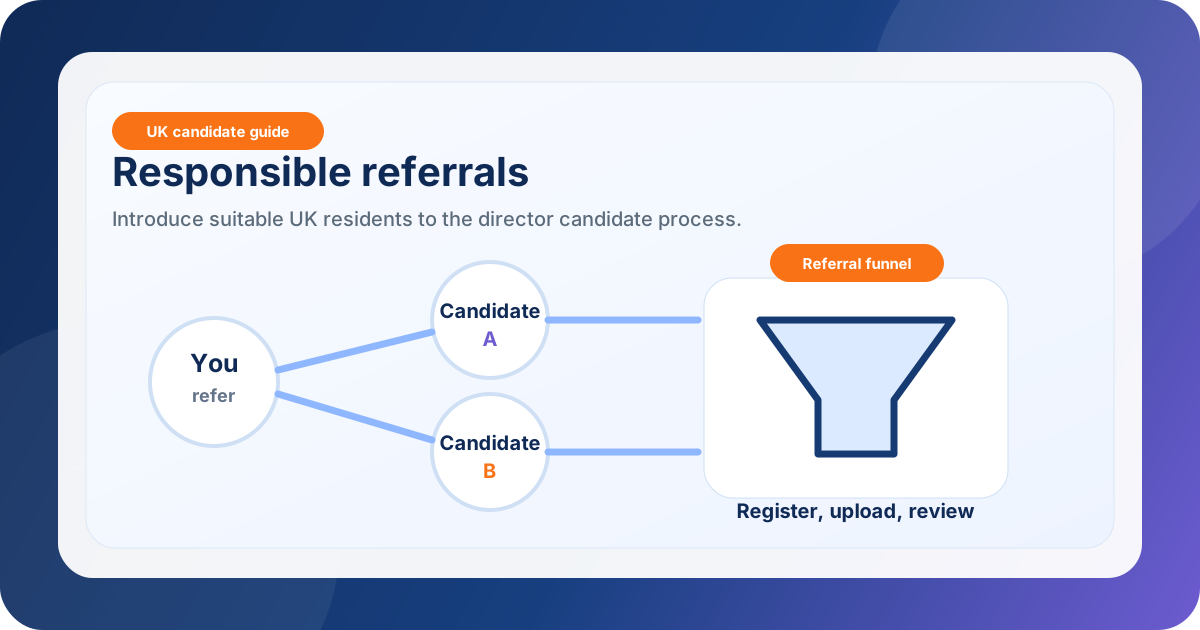
The safest answer to how to refer someone for a director opportunity safely is to ask whether they want neutral information, send a link only if they agree, and let them make contact themselves. Do not submit their email or telephone number, collect documents for them, or promise acceptance, appointment, payment or safety. A nominee director is a legal director, not a passive or anonymous participant.
Follow a consent-led introduction
A responsible introduction has five steps:
- Ask whether the person wants information about a formal company-director office.
- Explain the duties and public-record consequences before discussing money.
- If they agree, forward a neutral educational link from your own account.
- Let them choose whether to approach the service and what data to provide.
- Treat no, uncertainty or silence as a decision to stop.
Do not copy the service into the message or ask it to call the person. The candidate should control the first contact and every later decision.
Put the legal office before the opportunity
“Nominee” describes an arrangement; it is not a lower-responsibility status at Companies House. The official Being a company director guidance says the seven general duties still apply when a director is inactive or someone else tells them what to do.
An appointed person must be able to exercise independent judgement, obtain enough information, use reasonable care, manage conflicts and refuse improper instructions. A private agreement may divide routine tasks, but it cannot transfer away those duties. Ask the person to read the director responsibilities overview before they consider any form.
Appointment also has a public consequence. Companies House generally publishes a director’s name, nationality, month and year of birth, service address and appointment details. Its personal-information guidance explains that a full date of birth and usual residential address are normally kept off the public register. This does not make the appointment anonymous, and a home address can become public if used in a public field or document.
Do not call the role passive income, easy money, lending a name or “no work”. Those descriptions prevent an informed decision.
Ask a narrow question without pressure
A neutral message could say:
Would you like a link explaining a possible company-director role? It involves legal duties and public visibility. There is no guarantee of acceptance, appointment, fees or payment, and you do not need to respond.
Agreement to receive one link is not agreement to be contacted by a platform, apply, undergo checks, share documents or accept an appointment.
Do not infer agreement because the person is a friend, relative or colleague. Do not follow up repeatedly, set an artificial deadline or suggest they owe you a response. If they hesitate, stop.
Avoid an electronic-marketing referral
Email and text messages promoting an opportunity can be direct marketing under the Privacy and Electronic Communications Regulations (PECR). The ICO’s electronic-mail guidance says consent is generally required for marketing to individuals unless every condition of a permitted exception applies.
The soft opt-in cannot be used for a refer-a-friend scheme. The ICO also says an organisation that encourages, scripts, rewards or provides a system for people to pass on its marketing is likely to be instigating the messages. A referrer’s statement that a friend “will be interested” is not evidence of specific, informed consent to marketing from the organisation.
Any consent relied on must identify the organisation and type of message, be freely given and capable of proof. Marketing messages must identify the sender and provide the required way to object or unsubscribe. A private, independent recommendation may have a different analysis, but that distinction cannot be manufactured by routing an organisation’s campaign through an individual.
The safer boundary is to ask whether the person wants one neutral educational link, send it yourself only after they say yes, and avoid a platform that automatically emails or texts them. Do not forward reward, ease or guaranteed-income claims, and do not create an application in their name.
Do not create an Article 14 problem
An email address or telephone number is personal data. Where an organisation receives it from a referrer rather than from the person, Article 14 of the UK GDPR requires transparency unless a specific exception applies.
The ICO’s privacy-information guidance says the notice should cover the controller’s identity and contact details, purposes, lawful basis, data categories, recipients, retention, rights, the source of the data and relevant transfers or automated decisions. It must normally be given within one month, at the first communication if that occurs sooner, or before the first disclosure to another recipient.
The person should also be told about the right to object to direct marketing. Neither the controller nor the referrer should assume that providing this information late cures an unsolicited marketing contact. Letting the person approach the service directly avoids an unnecessary indirect transfer and allows them to read the privacy information before choosing what to submit.
Never handle the candidate’s documents
Do not request, receive, photograph, store or forward another person’s:
- passport, driving licence or selfie;
- proof of address;
- bank statement, account details or payment card;
- National Insurance number or tax document;
- health, benefit, immigration or criminal-record information;
- Companies House personal code, company authentication code, password or one-time passcode.
If the candidate proceeds, they should verify the recipient, purpose, lawful basis, minimum necessary document, redaction options, retention and deletion arrangements. They should then use the recipient’s verified, purpose-specific channel themselves.
Companies House identity verification, a provider’s AML customer due diligence and a website’s own screening are separate. A referrer cannot complete any of them by collecting files.
Do not treat vulnerability as suitability
Retirement, unemployment, remote working, financial need or prior business experience does not prove that someone is suitable. Financial pressure may make an incentive more coercive.
Pause if the person:
- seems to be agreeing so that you can receive a reward;
- cannot explain the basic duties after reading them;
- is being hurried by a partner, employer or business owner;
- has unresolved employment, professional, benefit or tax questions;
- lacks time or access to company information;
- is uncomfortable with a searchable public appointment.
The site’s eligibility information describes programme screening criteria. Those criteria are not a promise of legal suitability, acceptance or matching for a particular company.
Disclose incentives and connections
Before sending anything, say if you might receive a benefit, work for the service or proposed company, know its controllers, or have another reason to want the introduction. The candidate should be able to assess your objectivity.
Do not say that a cash bonus or other payment is available unless current written terms establish it. This article does not confirm a referral programme, amount or timetable. Relevant terms would need to identify:
- the legal payer;
- who may refer and be referred;
- the qualifying event;
- exclusions and duplicate-referral rules;
- any appointment or continued-service condition;
- payment timing and method;
- cancellation, misconduct and dispute provisions;
- possible tax treatment.
If you cannot verify those points, leave the reward out of the conversation. No referrer reward is guaranteed, and no candidate fee or payment is guaranteed. A referral reward, if validly offered, depends on its own current written terms; a director fee depends on a separate appointment and payment obligation. One does not trigger or prove the other. A candidate should never continue so that a referrer can get paid, and neither party should assume a tax allowance or outcome.
Compare two fictional situations
Proportionate: Sara asks Imran whether he wants neutral information. After he says yes, she sends the duties, public-register and eligibility links. She discloses that a reward might apply under separate terms but makes no promise. Imran independently decides whether to contact the service.
Stop: Jack enters a colleague’s mobile number in a form, calls the role easy income and offers to forward a passport. The colleague has not agreed to platform contact. Jack should submit nothing, delete any copied material and correct his description.
These examples illustrate decisions; they are not accounts of actual applicants.
Check the message before sending it
You should be able to answer yes to each question:
- Has the adult freely asked for this information?
- Have I put duties and public visibility first?
- Is the message neutral and free from urgency?
- Have I avoided predictions about safety, acceptance, appointment and payment?
- Will the person contact the service themselves?
- Will I remain outside all document and identity checks?
- Have I disclosed my incentive or connection?
- Can the person decline without being chased?
If any answer is no or uncertain, do not refer. You can instead offer the independent guide to checking whether a paid nominee director opportunity is real and leave the decision with them.
Respect a refusal or pause
One neutral introduction is enough. Do not monitor an application or ask someone to justify declining. If they proceed, they should verify the service and proposed company, read the actual appointment documents and obtain independent advice where needed.
A refusal, pause or request for professional advice is a responsible outcome. The aim is informed choice, not a completed referral.
Frequently asked questions
Can I submit a friend's contact details with their permission?
The lower-risk route is still to send a neutral link and let the person make contact. That makes their choice clear and avoids an unnecessary transfer of personal data.
Can I say that a suitable person will be accepted?
No. Suitability, screening, matching and appointment depend on facts a referrer cannot decide. Never predict acceptance or a fee.
May I collect KYC documents to help?
No. Do not receive, copy, store or forward another person's identity, address, bank, tax or other sensitive records. They should deal directly with a verified recipient through a purpose-specific channel.
Does a successful introduction guarantee a reward?
No. Only current written terms can create a conditional entitlement. Check the payer, qualifying event, exclusions, cancellation provisions, timing and possible tax treatment.
Official sources and further reading
Access dates are shown for each source. Rules and guidance can change; reopen the source before relying on a time-sensitive point.
- How do we comply with the PECR electronic mail marketing rules? — Information Commissioner's Office; accessed 19 July 2026
- What privacy information should we provide? — Information Commissioner's Office; accessed 19 July 2026
- Being a company director — Companies House; accessed 19 July 2026
- Your personal information on the Companies House register — Companies House; accessed 19 July 2026