
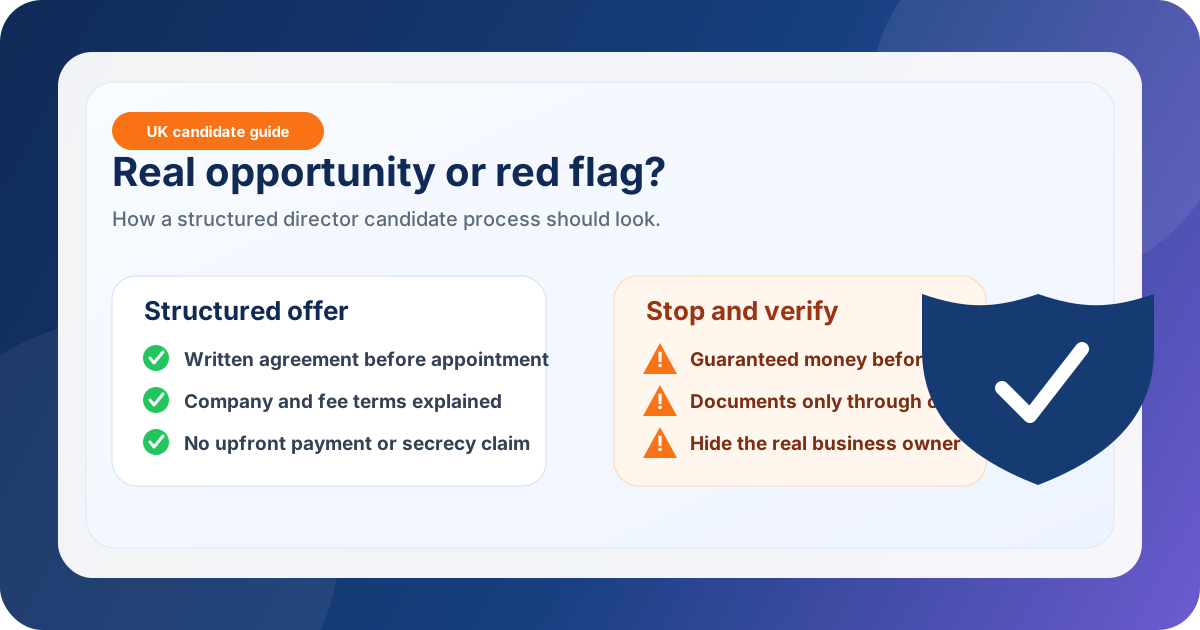
A paid appointment can be genuine, but a nominee director scam can use real company details, convincing documents and legal language. No website, company number, contract, identity check or regulatory entry proves the whole offer. Verify each claim independently: who contacted you, which entity provides the service, which company would appoint you, who controls it, why the role exists, who pays and what you would be expected to do.
If appointed, you hold a real legal office. “Nominee” is not a lower-responsibility category. An offer based on lending your name while remaining deliberately uninformed is unsafe, whatever fee is mentioned.
Current site status — checked 19 July 2026: the published materials do not yet let a reader independently verify the operating legal entity, complete data-controller details, AML supervisory status or ACSP status. Do not use the public document-upload route. Wait for a case-specific invitation and verify the recipient, purpose and privacy information first.
Use this page at first contact. Once a specific company is named, move to the company-verification workflow; when the complete appointment pack arrives, use the final red-flags checklist.
Decide whether to continue, pause or stop
Use the checks below while an opportunity is still being assessed. There are three proportionate outcomes:
- continue checking because the basic claims can be verified;
- pause because material information or independent advice is missing;
- stop and seek help because the request involves deception, unexplained money, misuse of identity or loss of account control.
“Real” is not the same as “safe” or “suitable”. A genuine company can make a poor or unlawful proposal, and a fraudster can impersonate a genuine company. This guide cannot certify a named provider or determine whether particular conduct is criminal. If you have already been appointed, transferred money or supplied sensitive documents, obtain advice for those facts.
Do not let money narrow the decision to “Will I be paid?”. The more important questions are whether you can lawfully perform the office, obtain reliable information, challenge instructions and leave without concealing a problem. A fee does not compensate for conduct you should refuse, and a missed payment is not the only possible harm.
Check claims separately, not by overall impression
Fraud becomes easier when one true detail lends credibility to everything else. Keep each claim and its evidence separate.
“The company exists”
Search its company number on Companies House. This shows what is registered. It does not prove that the contact represents the company, that its trading activity matches the filings, or that the offer is genuine.
Companies House says its search information is not comprehensive and may contain occasional inaccuracies (official search guidance). It performs basic checks on accounts rather than auditing the business. Registration is not government approval.
“The provider is AML supervised”
Ask for the supervisor, registered legal or trading name and registration details. Check the relevant official register yourself. HMRC expressly says that appearing on its supervised-business register is not an endorsement of a commercial transaction.
Where a business acts as, or arranges for another person to act as, a director by way of business, trust or company service provider rules may apply. HMRC distinguishes that activity from ordinary recruitment (official TCSP guidance). A provider should be able to explain its classification; calling itself a recruiter does not settle the point.
“We are authorised by Companies House”
If the provider says it can verify identity for Companies House, ask whether it is an Authorised Corporate Service Provider. Check the official ACSP material and the ceased or suspended list. Companies House warns that its published list covers agents who asked to be listed and may be incomplete or out of date. Even confirmed ACSP status is not approval of a particular appointment.
“You will be paid and protected”
Ask for written terms naming the payer, amount or calculation, payment trigger, schedule and proposed tax handling. Request the actual indemnity and D&O insurance wording, not a sales summary. A promise may create contractual rights, but it still depends on its terms and the payer’s ability to perform. Applying, completing checks or being appointed does not guarantee payment.
Verify the person and provider
Obtain the provider’s full legal name, company number, trading name, registered office, operational contact details, and the name and position of the person making the offer. Its contract, privacy notice, email domain and payment details should tell a consistent story.
Do not verify a contact only through links or telephone numbers that the same person supplied. Find the official record independently, then use a separately sourced channel to ask whether the person and offer are genuine. A copied logo, cloned website or spoofed display name can appear convincing.
Look for unexplained inconsistencies rather than treating a tidy website as proof. Examples include a contract naming a different entity, payment instructions for a personal account, a privacy notice that does not identify the controller, or a claimed supervisor that cannot be matched to the legal name.
Verify the proposed company and controllers
You need the exact company name and number before consent. “One of our clients” is not enough at the appointment stage.
Review the Companies House record for:
- status, incorporation date and registered office;
- stated nature of business;
- current and resigned officers;
- PSC information;
- filing history and document images;
- accounts and confirmation-statement dates;
- charges and available insolvency information.
These facts prompt questions; they do not produce a safety score. A new company is not automatically fraudulent, while an old company can be hijacked or misrepresented. Filed accounts may be limited, out of date or inaccurate.
Ask who ultimately owns or controls the company, what it genuinely does and why it wants an external director. Compare the explanation with the PSC record, appointment documents and information obtained directly from relevant parties. A nominee appointment cannot make the true controller disappear from legal disclosure or due diligence.
For the full sequence, follow how to check a company before becoming a director.
Test the offer against a director’s real duties
Companies House explains that the seven general duties apply even when a director is not active or another person tells them what to do. A director must still exercise independent judgement and reasonable care, skill and diligence.
Before consent, obtain a readable appointment pack covering:
- the company, parties and proposed start date;
- expected work and decisions reserved for the board;
- access to accounting, banking, tax and material contract information;
- filing arrangements and how you can verify submissions;
- conflicts, disagreement and escalation;
- the fee payer, trigger and documented tax treatment;
- resignation and handover;
- any indemnity and insurance.
“The owner handles everything” is not an answer. A director may use employees and advisers, but cannot outsource independent judgement or all oversight. Read the director responsibilities before comparing the role with any fee.
Confirm that each contracting party exists, has authority to sign and can plausibly meet its obligations. A written contract is useful evidence, not a guarantee of legality, payment or safety.
Check identity requests on their own merits
Some identity checks are legitimate, but three processes must remain distinct:
- Companies House identity verification;
- AML customer due diligence by a regulated provider;
- a website’s application or onboarding checks.
Completing one does not automatically complete the others. Uploading a passport to a provider does not by itself mean that Companies House has verified you.
Before sending a passport, selfie, proof of address or financial document, identify:
- the data controller and verified recipient;
- the purpose and necessity of each item;
- less intrusive or redacted alternatives;
- the authorised transmission route;
- who can access the data;
- retention, deletion and incident procedures.
Do not send online banking credentials, one-time passcodes or remote-access permission. If a bank document is said to be needed only for payment, ask whether a narrower account-confirmation document is sufficient. A polished portal is not evidence of safe data handling.
Know which requests mean stop
Stop if you are asked to:
- hide an owner, controller or the company’s true purpose;
- claim knowledge or activity that is not true;
- sign blank, unread, backdated or inaccurate papers;
- open an account, receive funds or forward money for an unexplained purpose;
- give up banking credentials, authentication codes or control of a device;
- pay an unexplained advance charge to release a role or earnings;
- mislead Companies House, a bank, platform, customer, regulator or adviser;
- accept immediately or avoid independent advice;
- rely on another person or an indemnity taking every responsibility.
None of this becomes acceptable because it appears in a contract or is described as customary. If a decision is close, use the shorter pre-appointment red-flag checklist.
Compare two illustrative situations
Continue checking: the provider gives a legal name consistent across its official record, contract and privacy information. An independently sourced contact confirms the employee. The company and controllers are identified, the commercial reason is coherent, and relevant supervision claims can be checked. You receive readable documents, enough time and a genuine opportunity for independent advice. These facts support further due diligence, not automatic acceptance.
Stop: a social-media contact promises fixed income for being “a name on paper”, will not identify the client until after you upload documents, asks for immediate bank access and says the owner must remain hidden. The contract claims that you have no responsibility. A larger fee or further assurance does not cure those problems.
These are hypothetical examples, not customer stories or estimates of how often fraud occurs.
What to do if you are concerned
Pause further payments, uploads and signatures. Preserve original messages, email details, telephone numbers, web addresses, documents, payment instructions and a dated chronology. Keep evidence intact. Do not send more information merely to test the contact.
If money moved or account access may be compromised, contact the bank through its official fraud channel. If a company used your name or address on the register without permission, use the Companies House reporting service. Its guidance also directs suspected crime to the national police fraud-reporting route, with Police Scotland used for companies registered in Scotland.
If you are already a director, resignation alone does not resolve past conduct or immediate risks. Independent legal advice can address which decisions must stop, which company records to preserve, how to document objections and whether an official report is appropriate.
Record your decision
Proceed only if every answer is “yes”:
- I independently confirmed the contact’s identity and authority.
- I checked the provider’s legal entity and relevant regulatory claims.
- I reviewed the exact company’s filings, officers and PSC information.
- The controllers, business purpose and reason for the appointment make sense together.
- Final terms identify the duties, information access, payer, payment trigger and exit.
- I will have enough information to exercise independent judgement.
- Every document request has a verified recipient, necessary purpose and clear privacy treatment.
- Nothing involves false information, hidden control, unexplained funds, account credentials or pressure.
- I can obtain independent advice and decline.
A “no” or “not sure” means pause. Verify the missing fact instead of letting another positive signal substitute for it. Then read when a nominee director arrangement can be lawful. Choosing not to proceed is a sound outcome.
Frequently asked questions
Does a Companies House company number prove that an offer is genuine?
No. It proves that a registered record exists. It does not prove that the person contacting you represents that company, that filed information is complete, or that an appointment or payment promise is genuine.
Is an upfront fee always proof of a nominee director scam?
Not every fee in every professional transaction proves fraud, but an unexplained payment demanded to unlock an appointment, especially under pressure or to a personal or unrelated account, is a strong reason to stop and verify independently.
Does a written contract make a nominee director role safe?
No. Written terms are important evidence, but cannot remove statutory director duties or make an unlawful purpose lawful. The parties, company, scope, fee, information rights, exit terms and any indemnity still need independent review.
Should I send a passport copy for director checks?
Only after identifying the data controller, checking the purpose and lawful process, reading the privacy information, confirming the channel and understanding retention and deletion. Companies House verification, provider AML checks and a website's onboarding are separate processes.
What if my details were used for a company role without permission?
Use the Companies House process for reporting personal details used without permission. Preserve the evidence and use the appropriate official fraud-reporting route if you believe a crime has occurred.
Official sources and further reading
Access dates are shown for each source. Rules and guidance can change; reopen the source before relying on a time-sensitive point.
- Searching the Companies House register — Companies House; accessed 19 July 2026
- Being a company director — Companies House; accessed 19 July 2026
- Check if you need to register for money laundering supervision as a trust or company service provider — HM Revenue & Customs; accessed 19 July 2026
- Check if a business is registered for money laundering supervision — HM Revenue & Customs; accessed 19 July 2026
- List of Authorised Corporate Service Providers — Companies House; accessed 19 July 2026
- Report a company using your personal details without your permission — Companies House; accessed 19 July 2026