
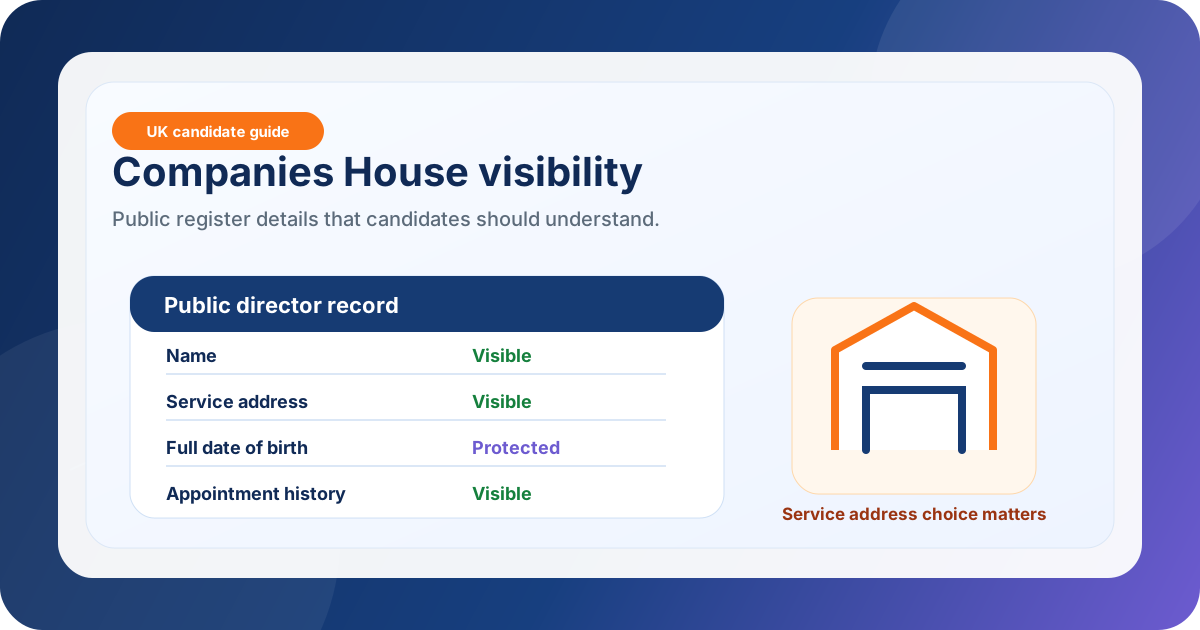
Yes. If you are formally appointed as a UK company director, your name and core appointment details will normally be public on the Companies House register. Anyone can search the register online, including from outside the UK, and public data can appear in search engines and third-party databases.
Your usual residential address and complete date of birth normally stay off the public register. Companies House retains them privately, however, and can disclose them to specified bodies where the law permits. Your home can also become public if it is used as a service address, registered office or in another public field.
A nominee label does not change the public record
Companies House records the legal office of director. It does not publish a separate “nominee director” category with less responsibility or greater privacy. If an arrangement results in your formal appointment, the standard director disclosure rules apply.
The same principle governs your duties. Written terms can allocate day-to-day work, but they cannot remove a director’s duties to exercise independent judgement and reasonable care, skill and diligence. A person promising that you will be anonymous, passive or “only a name” is describing neither the public record nor the legal office accurately.
This guide is for prospective, current and former directors who want a general overview. It cannot decide whether a disputed appointment is legally valid or whether an individual meets the criteria for special protection.
What the public can normally see
As at 19 July 2026, Companies House identifies these standard public director details:
- name;
- nationality;
- month and year of birth;
- service address;
- the company appointment and its start date; and
- the termination date after a departure has been notified and registered.
The company page adds context. Its filing history may include appointment documents, confirmation statements, accounts, charges and address changes. Information about people with significant control appears separately where the applicable disclosure rules require it.
Current guidance does not list occupation as a standard public field for a new director. Some historic appointment documents nevertheless include a business occupation because older forms required it. It is therefore unsafe to assume that every old document contains only the fields collected today.
An officer profile is not the whole record
The officer profile summarises a current or former appointment. Filing-history images preserve documents submitted at particular times. An older image may contain a home address, signature, day of birth or occupation that is absent from the present profile.
Changing a current address does not automatically rewrite those images. To understand what is actually public, search the company, review the officer entry and open the relevant filings.
What normally stays off the public register
Companies House requires a director’s usual residential address and full date of birth, but normally holds them on a private register.
This is limited confidentiality, not secrecy from every institution. Companies House guidance says it may provide those details to credit reference agencies and specified public authorities, such as the police, in legally permitted circumstances. “Not publicly displayed” is more accurate than “nobody else can access it”.
For directors appointed after 10 October 2015, only the birth month and year are generally displayed. A document filed before that date may include the day. If an older appointment is involved, inspect the document rather than applying the current convention retrospectively.
Service address, residential address and registered office
These addresses have different functions:
- A service address is the director’s public correspondence address.
- A usual residential address is where the director lives and is normally held privately.
- A registered office is the company’s own official public address.
One location can serve more than one function, but publication follows the field in which it appears. A home supplied only as the residential address normally stays private. The same home used as the director’s service address or the company’s registered office becomes public.
A non-residential service address is not just a privacy device. You need permission to use it, and company-related correspondence must reach you reliably. Missing an official notice because someone else controls the address can prevent you from responding properly. Read the detailed comparison of service and residential addresses before consenting to a filing.
Public information can travel beyond Companies House
Companies House offers a free public search, data products and application programming interfaces. Search engines may display register pages, while commercial services can copy information that is lawfully public.
Companies House cannot control copies held by third parties. Those organisations are responsible for their own data-protection compliance. If the official record changes while a search result or commercial profile remains stale, you may need to contact the third-party operator or search engine separately.
First establish where the mismatch sits:
- Save the official and third-party URLs.
- Compare the fields and document dates.
- Check whether Companies House itself is correct.
- Keep dated copies of correction or removal requests.
This evidence helps distinguish a stale third-party cache from an unresolved filing at Companies House.
Resignation ends the office, not its history
A valid resignation ends the office in accordance with the company’s articles and any applicable contractual terms. Once the company notifies Companies House and the notice is registered, the public record should show the appointment as ended with a termination date.
The former appointment remains visible. Companies House says information about resigned officers stays on the public register throughout the company’s lifetime, including where the company is dormant.
Current guidance says dissolved-company information remains on the register for 20 years. Companies House is reviewing that retention period and has paused destruction and transfer during the review. The accurate conclusion is that information is retained under the current rule, not that it is removed on resignation or guaranteed to remain online forever.
If your entry still says active, investigate the filing rather than asking for ordinary historical data to be deleted. The guide to a resigned director still showing on Companies House distinguishes a missing or rejected notification from a correctly retained former-director record.
Defined personal details can sometimes be removed
Companies House provides an application route for specified personal details in public documents. Since 21 July 2025, the published categories include:
- a home address used as a service or correspondence address, and certain registered-office uses;
- the day of a date of birth in a document filed before 10 October 2015;
- a signature in an eligible document; and
- a business occupation where it was required.
This route is document-specific. The applicant identifies each affected document, pays the applicable fee for each and meets any evidence or replacement-address conditions. A serving officer normally needs to give an alternative address if their current correspondence address is removed. An active company must first change a home address that remains its current registered office.
The application does not remove the director’s name, erase the appointment or guarantee that every third-party copy will disappear. Start by listing the exact documents, then follow the current Companies House personal-details removal guidance.
Companies House also explains that a statutory-register exemption limits certain UK GDPR erasure and rectification requests. A general “right to be forgotten” request is not a substitute for the specific procedure.
Serious-risk protection is not ordinary anonymity
A director can apply to restrict disclosure of their home address to credit reference agencies if they, or someone living with them, face a serious risk of violence or intimidation because of the company’s activities. Specified public authorities can still request the address.
Protection of all public identity information is a separate measure for qualifying people with significant control. It is not available to every director who would prefer anonymity. Check the official criteria, evidence requirements and current fee rather than assuming that an application will succeed.
If a qualifying risk is foreseeable, consider the official route before appointment. For an immediate threat, contact the police or appropriate emergency service; a Companies House application is not an emergency response.
Two illustrative decisions
Possible to continue: Lena accepts that her name, nationality, birth month and year, service address and appointment will be public. She has permission to use a non-residential address that forwards correspondence promptly. She checks the proposed company and continues to review the agreement and director responsibilities.
Pause or decline: Owen is told that a nominee appointment is invisible and that resignation will delete it. The organiser wants his flat used as both service address and registered office, but will not identify the company’s controller. Those statements are wrong and the missing information is material. Owen should not consent while those issues remain.
These are illustrative examples, not real applicant histories or assurances about any appointment.
Decide with the lasting record in view
Before accepting an appointment, answer yes, no or not sure:
- Am I willing to have my name and appointment history publicly searchable?
- Do I know which address will be shown and how correspondence will reach me?
- Have I checked whether the filing history already contains private details?
- Has anyone promised anonymity or automatic deletion after resignation?
- Do I understand the difference between document removal and serious-risk protection?
- Can I perform the office properly despite any private nominee label?
A “not sure” answer is a reason to pause before giving consent or an address. Check the live register and current Companies House guidance. Obtain independent legal or data-protection advice if a filing is disputed, a credible threat exists or the appropriate application route is unclear.
Frequently asked questions
Can I keep my home address off Companies House?
Usually, if you provide it only as your usual residential address and use a suitable different service address. A home used as a service address, registered office or in another public document can become public.
Is a director's complete date of birth public?
Companies House receives the complete date. For directors appointed after 10 October 2015, the public register generally displays only the month and year, although older document images may show the day.
Does a director disappear when the company files TM01?
No. A termination filing should record that the appointment ended and show the end date. The former directorship remains part of the company's public history.
Can UK GDPR erase a Companies House directorship?
There is no general right that automatically erases a lawful directorship record. Companies House relies on statutory-register exemptions, while separate procedures cover specified personal details, false information and defined serious-risk cases.
Official sources and further reading
Access dates are shown for each source. Rules and guidance can change; reopen the source before relying on a time-sensitive point.
- Your personal information on the Companies House register — Companies House; accessed 19 July 2026
- Removing your personal details from the Companies House register — Companies House; accessed 19 July 2026
- Apply to protect your details on the Companies House register — Companies House; accessed 19 July 2026
- Being a company director — GOV.UK; accessed 19 July 2026