
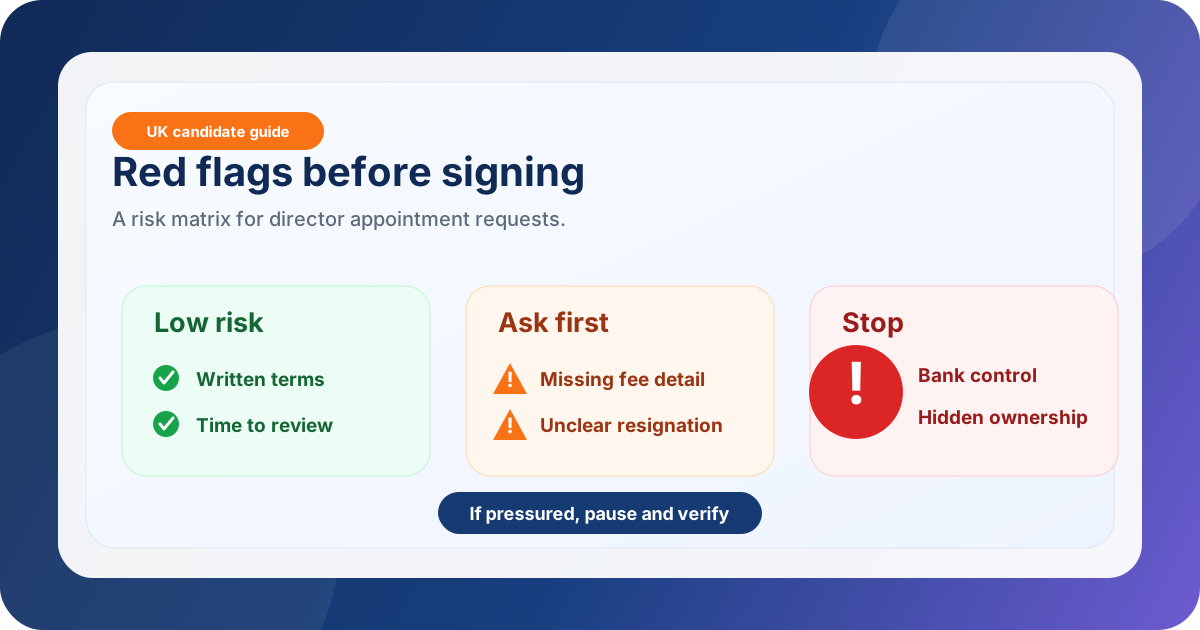
This red-flags checklist is for the point just before acceptance, when the company and complete appointment pack should already be available. Stop if you cannot identify who controls the company, why you are needed, what you must do or who will pay. Do not sign blank, unread, false or backdated documents; move company money through a personal account; share one-time passcodes; or agree to conceal an owner. If the approach or company has not yet been verified, first use the scam guide and company-verification workflow.
Start with the legal reality
A nominee director is still a director in law. Companies House does not create a reduced-responsibility “nominee” office. The official director guidance says the seven general duties continue to apply when a director is inactive or someone else tells them what to do. Those duties include independent judgement and reasonable care, skill and diligence.
That means an offer is fundamentally unsafe if its selling point is that you will only lend your name, remain ignorant or obey another person without question. Written terms can allocate day-to-day tasks, but they cannot transfer your judgement or supervision duties to an owner, agent or platform. Read the director responsibilities overview before assessing the commercial details.
The checks below do not decide whether a particular arrangement is lawful. They identify facts that justify stopping or obtaining independent legal, insolvency, tax or fraud advice.
Stop: the owner or purpose is being hidden
You should be told the identity of the proposed company, the people who ultimately own or control it, the client in the arrangement and the commercial reason for appointing you. Stop if a contact:
- says the beneficial owner must not be disclosed to a bank, provider or authority;
- asks you to repeat a misleading ownership or control story;
- refuses to explain who will give instructions or benefit from the business;
- wants your name to distance a disqualified or sanctioned person from the company; or
- treats a nominee appointment as a way around PSC, AML or customer checks.
The HMRC guidance for trust or company service providers explains that acting, or arranging for another person to act, as a director by way of business can be a regulated TCSP service. It also distinguishes this from ordinary recruitment. Do not infer that a provider is supervised merely because it describes its process as “KYC” or “compliant”; ask for the legal entity and verifiable supervisor details.
Stop: the papers cannot withstand scrutiny
Never sign a blank form, an incomplete board minute or a document you have not read. Treat requests to backdate a resolution, confirm a meeting that did not happen, state that goods or services existed when they did not, or approve accounts you cannot assess as stop signals.
A claim that “the accountant has checked it” is not enough. Ask for the final version, supporting records, enough time to read it and a direct route to the relevant professional. Verify that professional independently rather than using only contact details supplied in a message.
Electronic signatures do not lower the need to understand the document. Refuse any request to share a Companies House personal code, banking security credential, one-time passcode or remote-access session without a verified purpose and trusted recipient. Companies House’s personal-code guidance explains the limited filing purpose. A personal code is not a general delegation of your authority.
Stop: money or banking is unexplained
Do not use your personal bank account to receive, hold or forward company, customer or investor money. Do not open accounts using a false business description, accept cash for onward transfer, buy crypto for someone else, or let another person operate an account in your name. These requests can expose you to fraud, money-laundering and personal-debt risks that are different from the company’s ordinary liabilities.
Being told that you will not have day-to-day banking access is not automatically reassuring either. A director still needs enough reliable information to oversee the company and question unusual transactions. If the contact will not provide bank information, management accounts, cash-flow information or an explanation of material payments appropriate to the role, pause.
Financial difficulty is not, by itself, proof of fraud or director misconduct. It does make accurate information and timely insolvency advice more important. The distinction between company failure and personal wrongdoing is explained in our guide to what happens when a company goes bust.
Stop: pressure replaces evidence
High-pressure messages are designed to prevent checking. Warning signs include:
- a same-day deadline with no credible commercial reason;
- threats that questions will lose you a guaranteed fee;
- instructions not to speak to a solicitor, accountant, bank or family member;
- repeated movement to private or disappearing-message channels;
- a demand for an upfront payment before you can see the company or agreement; and
- promises of risk-free income, complete anonymity or protection from every claim.
No provider can guarantee that applying will result in an appointment or payment. An indemnity is not a substitute for the appointment checks: it is a contractual promise whose legality, scope, exclusions and financial value must be assessed.
Stop: the named company does not withstand its own checks
This final checklist does not repeat the full company investigation. Pause where the registered status, filing chronology, officers, people with significant control, accounts, charges, business description or current financial information does not match the proposal.
Use the complete company-verification workflow and require a documented explanation. A Companies House entry remains evidence to test, not government approval or proof that the contact has authority.
Stop: identity and personal data requests are premature or vague
Identity checks can have a lawful purpose, but the requester should provide the controller, purpose, lawful basis, recipients, retention period and rights information set out in the ICO’s right-to-be-informed guidance. Companies House identity verification, a regulated provider’s AML due diligence and a website’s own onboarding are separate processes.
Do not upload a passport, selfie, proof of address or bank statement merely because a public form exists. First verify who operates it and why each document is necessary. Ask whether less intrusive or redacted evidence is accepted. Stop if you are asked for passwords, banking logins, authentication codes or remote control of your device; those are not identity documents.
Check: the payer, indemnifier and exit route
Before accepting, identify the legal person that owes each promise. The company offering the appointment, the business owner, an intermediary and an indemnifier may be different parties.
For fees, obtain the payer’s name, amount or calculation method, trigger, schedule, PAYE treatment, expenses and consequences of early termination in writing. A promise is only as useful as its terms and the payer’s ability and willingness to perform; do not treat a fee as guaranteed income.
For any indemnity or D&O insurance, request the actual wording, policy schedule, limits, exclusions, notification requirements and run-off arrangements. Do not accept “fully indemnified” as an answer. The personal-liability guide explains why company debts usually remain company debts but particular conduct, guarantees and insolvency provisions can create personal exposure.
The appointment documents should also explain information access, notice, resignation, company-property return, unpaid fees and continuing confidentiality. An agreement that lets the other party block all contact, withhold records indefinitely or impose an unrealistic exit mechanism deserves independent review. Resignation does not erase liability for acts or omissions while in office.
Use a stop, check, proceed decision
Stop where the proposal requires deception, hidden control, personal money transfers, unsafe credentials, unread documents or fabricated records. Do not try to make an unlawful instruction safe by adding a side letter.
Check where facts are missing but could have an innocent explanation. Ask for original records, verify them outside the contact’s communication chain and record unanswered questions. “Not sure” means pause, not assume.
Proceed only to independent review when the company, controllers, purpose, duties, information rights, payment, data use, indemnity, insurance and exit terms are coherent and verifiable. That is not a finding that the appointment is safe. It is the point at which a solicitor and any relevant tax or insolvency adviser can assess the actual documents.
Two illustrative situations
A proposal that can move to review: the contact identifies the company and controllers, gives a consistent commercial reason, supplies final documents and current financial information, allows direct professional checks, explains information access and accepts that you may refuse. This is not approval; it means the proposal is capable of informed review.
A proposal to reject: the contact says you are “only a name”, asks you to sign an undated appointment and open an account, will not identify the owner, promises that an indemnity covers everything, and demands passport and bank-login details that evening. The combined facts call for stopping, preserving evidence and considering a report.
Preserve evidence and use the right official route
Keep the original messages, email headers, documents, URLs, payment details, names, telephone numbers and a dated note of calls. Do not alter files or continue a risky conversation merely to collect more evidence. Secure any account that may have been compromised and contact the relevant bank or service through its independently verified channel.
If a company has used your name or address without permission, Companies House provides an official personal-details misuse report. That page also directs suspected fraud to Report Fraud and explains the separate route for companies registered in Scotland. Immediate danger and live criminal activity require the appropriate emergency police route.
For a disputed appointment, threatened claim, insolvency concern or possible offence, obtain advice from a suitably qualified independent professional. General checklists cannot determine your personal liability or reporting duties.
Your next step
Write down every missing fact and request the evidence without accepting, paying or uploading sensitive documents. If any stop signal remains, decline. If the evidence is coherent, take the complete appointment package—not a marketing summary—to an independent solicitor before deciding.
Frequently asked questions
Is a written nominee director agreement a green flag?
It is evidence to examine, not proof that the appointment is lawful or safe. Check the parties, company, duties, information rights, fees, indemnity, insurance and exit terms, and have the actual document reviewed independently. No agreement can remove statutory director duties.
Should I pay an upfront fee to become a director?
An unexplained or pressured payment request is a warning sign. Do not pay merely to unlock an appointment. Verify the legal entity, the contractual basis and the recipient independently, and stop if the explanation or evidence is unsatisfactory.
What if I am told I will never need to make decisions?
That description conflicts with the legal office. Directors must exercise independent judgement and reasonable care, skill and diligence even when others manage day-to-day work. Do not accept a role designed to keep you uninformed or make you follow instructions automatically.
Does a company with a Companies House number pass the check?
No. Registration confirms that a record exists; it is not government approval of the business, its controllers, the offer or its financial health. Read the filing history and verify the people, purpose and documents through independent channels.
Where should I report suspected identity misuse?
If a company has used your name or address at Companies House without permission, use the official Companies House reporting route. Suspected fraud may also need to be reported through Report Fraud, or Police Scotland where the official guidance directs. Preserve evidence and seek advice if you are unsure.
Official sources and further reading
Access dates are shown for each source. Rules and guidance can change; reopen the source before relying on a time-sensitive point.
- Being a company director — Companies House; accessed 19 July 2026
- Companies Act 2006, Part 10, Chapter 2 — legislation.gov.uk; accessed 19 July 2026
- Check if you need to register for money laundering supervision as a trust or company service provider — HM Revenue & Customs; accessed 19 July 2026
- Report a company using your personal details without your permission — Companies House; accessed 19 July 2026
- Companies House personal codes for identity verification — Companies House; accessed 19 July 2026
- What privacy information should we provide? — Information Commissioner's Office; accessed 19 July 2026