
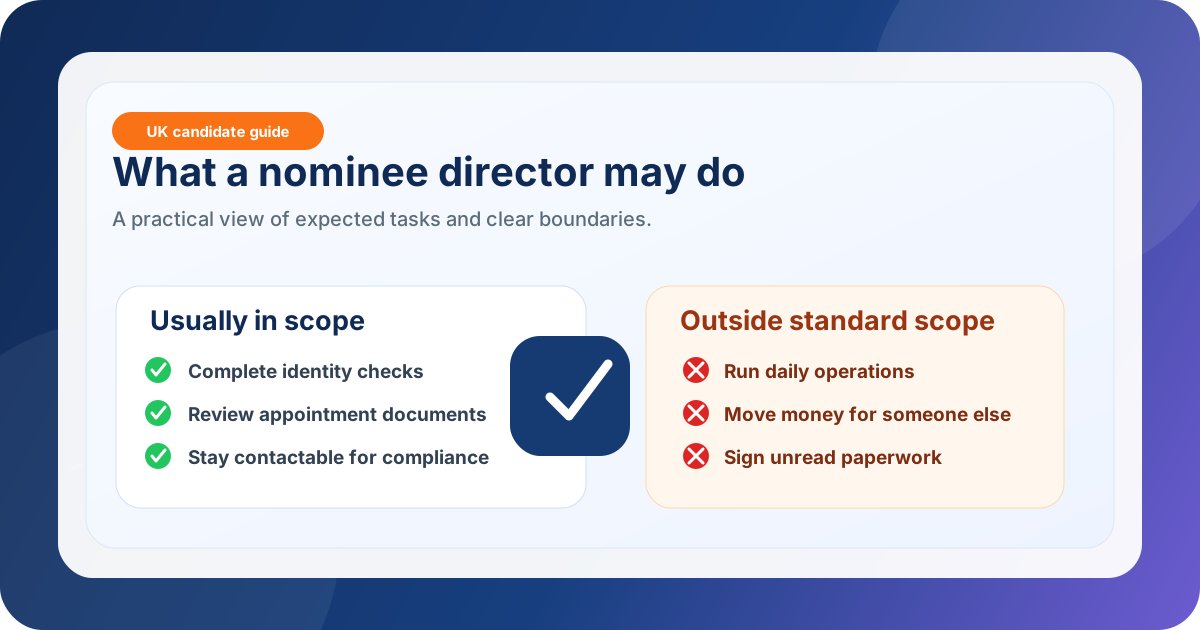
A nominee director investigates before accepting, consents to a formal appointment, participates in decisions and keeps enough oversight to act lawfully. Their job is not simply to appear on Companies House. Managers may run everyday operations, but the registered director must understand material issues, reach their own conclusions and refuse anything improper.
What is included in a nominee director appointment varies with the company and written terms. The legal minimum does not. For the definition and the parties involved, first read what a nominee director is in the UK.
Start with the legal office, not the task list
An appointment proposal may mix four different kinds of statement:
- UK law, which imposes duties on every registered director;
- official guidance, which explains a government process;
- programme policy, which sets a service’s applicant criteria; and
- appointment terms, which allocate tasks, information rights, fees and notice for one company.
Only the last category is negotiated for a particular role. A clause giving managers responsibility for daily operations does not alter the general duties in Companies Act 2006, sections 171 to 177. The director must still act within their powers, promote the company’s success, exercise independent judgement and use reasonable care, skill and diligence. They must also address conflicts, third-party benefits and interests in transactions.
Those duties are generally owed to the company. The person who nominates the director, arranges the introduction or pays a fee cannot replace that legal relationship.
Before appointment: investigate the proposal
Some of the most important work happens before the candidate says yes.
Establish what the company does and who controls it
Obtain the correct company name and number, articles, current filing history, latest available accounts and a clear description of the business. Identify the shareholders, people with significant control (PSCs), beneficial owners, existing directors and the people expected to manage operations.
Companies House records are a starting point, not a government warranty that a business or appointment is genuine. Differences between the register, the proposal and supporting documents need a satisfactory explanation.
Ask why the arrangement is proposed. A proper explanation should be capable of being written down and tested. A request to hide an owner, mislead a bank or platform, or bypass identity or ownership checks is not an unusual administrative condition. It is a reason to stop.
Read the appointment package
The proposed documents should state:
- the company and contracting parties;
- the appointment period and notice provisions;
- expected meetings, approvals and reporting;
- access to records, staff and advisers;
- who prepares filings and how they are checked;
- the fee payer, payment trigger and payroll treatment;
- conflicts, confidentiality and escalation arrangements;
- the resignation route; and
- any indemnity and directors’ and officers’ (D&O) insurance terms, including exclusions.
Clear terms make the workflow easier to assess. They do not reduce the statutory standard. Nor should a candidate treat an indemnity as a promise that every claim or cost will be paid. The Companies Act limits what can be exempted or indemnified, and a contractual payer may fail to perform.
Test whether real oversight is possible
Agree what financial and management information will be supplied, how often and by whom. Identify a route for urgent disclosure and a route to professional advice that does not depend entirely on the introducer.
Check personal constraints too. An employment contract, regulated profession, existing directorship or relationship with the nominator may create a restriction or conflict. If the answer depends on individual circumstances, obtain independent advice before consenting.
At appointment: verify the filing and public details
Consent should be informed and specific to the company. The director should check the appointment date and personal particulars and select a service address knowing that it will be public.
Companies House generally displays a director’s name, nationality, month and year of birth, service address and appointment details. The complete date of birth and usual residential address are normally kept off the public register, although a home address can become public if used in a public field or historic document.
Mandatory identity verification began on 18 November 2025. A new director appointed on or after that date must complete the Companies House process and provide a personal code for the incorporation or appointment filing. Use the official Companies House verification guidance for that process. A provider’s onboarding checks or AML due diligence serve separate purposes and do not automatically complete statutory verification.
Keep the signed terms, consent and filing confirmations, opening resolutions, conflict declarations and official identity-verification record. These establish what was agreed and what information existed at the start.
After appointment: receive, challenge, decide and follow up
The ongoing role is best understood as a decision cycle, not a fixed number of hours.
Receive useful information
Relevant reporting may include management accounts, cash and overdue liabilities, filing and tax status, major contracts, disputes, ownership changes and unusual transactions. The right level depends on the company, but information must arrive in time to support genuine decisions.
The director need not prepare every report. They should identify gaps, question inconsistencies and insist on an intelligible response. Repeatedly missing accounts or a single contact who refuses to provide source documents makes proper oversight impossible.
Challenge proposals
When asked to approve accounts, a contract, written resolution or filing, the director should read the material and understand the consequences. Managers and advisers may recommend a course of action. The director must not turn that recommendation into an automatic vote.
If a proposal benefits the nominator or a connected party, the director should identify the conflict and follow the articles and legal rules on declaration or authorisation. A fee does not buy the director’s agreement.
Decide and record
The director may attend board meetings, consider written resolutions and sign accurate documents within proper authority. If facts are missing, approval should be deferred rather than guessed. Minutes should reflect the decision actually made, including material questions or dissent where appropriate.
Contemporaneous records may include board papers, emails requesting clarification, minutes, written resolutions, conflict declarations and professional advice. They do not make an unreasonable decision reasonable, but they preserve the genuine process. They must never be reconstructed to disguise rubber-stamping.
Follow up and escalate
Check that conditions and action points are completed. A late filing, unexplained liability or suspicious payment should not wait for a nominal annual review.
Escalation may begin with a documented request and move to withholding approval or obtaining independent legal, accounting or insolvency advice. The Insolvency Service’s official insolvency-duty guidance explains that when a company is insolvent, directors’ priorities shift towards creditors. If the company is or may be unable to pay its debts, protect assets, preserve records, avoid worsening creditors’ position and obtain qualified insolvency advice. Reassurance from the owner is not a substitute.
Delegated work still needs supervision
Managers can supervise staff, deal with customers and make routine payments within approved authority. Accountants can maintain records and prepare accounts. Lawyers can advise on transactions. An administrative agent can prepare forms.
The director should know who has authority, what limits apply and how performance will be checked. GOV.UK guidance on being a company director confirms that legal responsibilities remain even when a director is not active in daily work or another person tells them what to do.
For accounts, confirmation statements and event-driven submissions, establish a filing calendar, review information requiring approval and act on errors. The company director filing responsibilities guide covers that process in depth. The broader director responsibilities overview explains the legal baseline.
Financial oversight is not the same as moving money
A director may not need daily online-banking access. They still need enough financial information to understand the company’s position and challenge material or unusual payments.
Appointment does not justify requests to receive third-party money personally, open an unexplained account, share a one-time password or grant remote access. A claimed need for speed does not replace a commercial explanation, proper authority and supporting records.
Directorship fees should have an identified payer and written conditions. HMRC’s published position is that fees for director work are generally employment income and should normally be handled through PAYE by the company in which the office is held. Keep the agreement, payslips and payment records. Where the package includes other services or payments, individual tax advice may be needed.
An unexpected gift or payment linked to a signature, vote or failure to act also raises conflict and third-party-benefit issues. It is not a routine addition to an agreed fee.
Refuse requests based on deception or blind trust
A director should not:
- sign a blank, unread, backdated or inaccurate document;
- confirm a meeting or decision that did not happen;
- conceal a beneficial owner or PSC;
- supply false information to Companies House, HMRC, a bank or platform;
- open an account or transfer unexplained third-party funds;
- hand over a personal code, login, password, one-time code or remote access without a verified lawful purpose;
- ignore missing records, financial distress or suspected unlawful conduct; or
- promise in advance to follow every instruction.
Refuse clearly and preserve the request. Ask for the explanation, authority and evidence in writing. If the concern remains, the appropriate options include declining the role, withholding approval, obtaining independent advice or considering resignation under the articles and contract. Resignation does not erase the appointment history or responsibility arising while in office.
Two illustrative proposals
A proposal that merits further checks
A candidate receives the articles, ownership information, filings, accounts, business explanation and complete draft terms. An identified contact will provide monthly financial reports. The director can inspect records, challenge proposals and refuse approval. Fee, PAYE and resignation terms are clear. Further due diligence may be reasonable, although none of these features guarantees that the role is suitable.
A proposal to reject
An introducer will not identify the owner and says the candidate must sign whenever messaged. Blank documents arrive with a request to open a bank account and forward access codes. The proposal prevents informed judgement and depends on secrecy. The candidate should stop, preserve the messages and neither sign nor provide credentials.
These examples are illustrative, not client accounts.
Check whether you can perform the real role
Before consenting, ask:
- Do I understand the business, ownership and reason for appointment?
- Will I receive reliable information before decisions and at suitable intervals?
- Can I challenge, defer and refuse?
- Are authority, fees, PAYE, conflicts, protection and exit terms documented?
- Can I retain records and reach independent advisers?
- Have I considered the public-register and personal consequences?
If any answer is “not sure”, request evidence and pause. Compare the proposed work with the statutory duties, check the company independently and obtain advice on the actual documents. Do not accept on the assumption that there will be nothing to do.
Frequently asked questions
Does a nominee director have to manage the business every day?
Not necessarily. Managers may handle daily operations, but the nominee director must still obtain sufficient information, supervise delegated work and discharge the duties attached to the office.
Can a business owner instruct a nominee director how to decide?
The owner can explain a proposal and express a preference. The director must nevertheless exercise independent judgement, act in the company's interests and handle any conflict properly.
May a nominee director refuse to sign a document?
Yes. A director should refuse if the document is unread, incomplete, inaccurate, unexplained or inconsistent with their duties, and should record why approval was withheld.
Does resignation remove earlier responsibility?
No. Resignation must comply with the articles and contractual terms, and it does not erase the public history or liabilities arising while the person was a director.
Official sources and further reading
Access dates are shown for each source. Rules and guidance can change; reopen the source before relying on a time-sensitive point.
- Companies Act 2006, Part 10, Chapter 2: General duties of directors — legislation.gov.uk; accessed 19 July 2026
- Being a company director — GOV.UK / Companies House; accessed 19 July 2026
- Verifying your identity for Companies House — GOV.UK / Companies House; accessed 19 July 2026
- Your personal information on the Companies House register — GOV.UK / Companies House; accessed 19 July 2026
- Director information hub: Director duties upon insolvency — The Insolvency Service; accessed 19 July 2026
- EIM02504: Employment income — directors' fees received by companies — HM Revenue & Customs; accessed 19 July 2026