
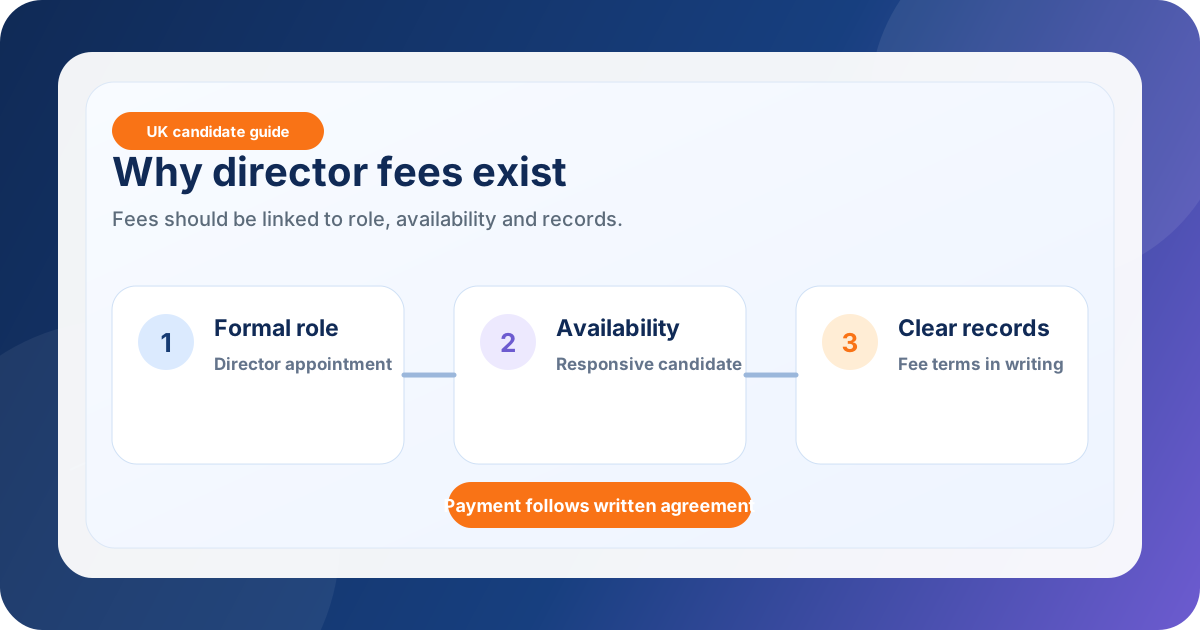
Companies may use nominee directors for a disclosed board-representation arrangement, genuine governance capacity or practical accessibility. The phrase itself proves nothing about a particular offer. The company must still disclose its real ownership and control, and anyone appointed must act as a director rather than lend their name.
A fee pays for a legal office and agreed work. It does not buy anonymity, unquestioning signatures or a route around somebody else’s checks. An application does not guarantee a match, a match does not guarantee an appointment, and an appointment does not guarantee payment.
Who this guide is for
This guide is for a UK resident who has seen or received a paid nominee director proposal and wants to understand the possible business explanation before deciding whether to investigate further.
It does not validate a provider, company or appointment. It also cannot decide whether a particular arrangement is lawful or suitable for you. A sound decision requires the actual company records, ownership facts, contract and tax treatment.
Ask four questions before discussing money
Start with the parties, purpose, powers and proof:
- Parties: who are the company, shareholders, PSCs, beneficial owners, managers, person making the approach and proposed fee payer?
- Purpose: why does this company need another director rather than merely another person’s identity?
- Powers: what records can the director inspect, which decisions must they consider, and how can they refuse?
- Proof: where are the appointment, scope, fee, payroll, conflict, insurance, indemnity and exit terms recorded?
A detailed fee schedule cannot cure an unidentified controller. A long task list cannot cure a role in which the director is denied information or expected to approve every request.
“Nominee” does not mean lower responsibility
Companies House records the appointee as a director. It does not create a separate, lower-responsibility nominee status. The Companies Act 2006 general duties apply in the ordinary way.
Those duties include acting within powers, promoting the company’s success, exercising independent judgement, using reasonable care, avoiding conflicts, refusing improper third-party benefits and declaring interests in proposed transactions. The Companies House guide for directors confirms that the duties still apply when a director is inactive or someone else tells them what to do.
A private contract can allocate day-to-day tasks. It cannot return final judgement to a founder, beneficial owner, platform or accountant. Read the director responsibilities overview before assessing the commercial explanation.
Reasons that may withstand further checks
These scenarios can have a coherent business basis. They are not endorsements. The parties, purpose and documents still need independent verification.
A documented board-representation right
An investor, parent company or commercial party may hold a contractual or shareholding-based right to nominate someone to a board. The documents should identify that right and explain the relationships between the paying company, appointing organisation and director.
The director may communicate the appointing organisation’s perspective. They must still make decisions under duties owed to the company whose board they join. Conflict and confidentiality procedures matter when interests diverge.
Genuine governance capacity
A board may need another person to review information, attend meetings, consider written resolutions or provide oversight. It should explain why that capacity is needed, what the candidate will receive and which matters require involvement.
Being “available to sign” is not governance capacity. A director needs time to ask questions, inspect supporting records and document disagreement. Automatic approval would contradict the stated purpose.
Relevant skill and challenge
A company may seek relevant commercial, financial or sector experience. That reason should appear in the role description and selection process. It should be matched by access to accurate information and appropriate advice.
Experience does not remove exposure. The standard of reasonable care takes account of a director’s actual knowledge, skill and experience. A claim that the role needs expertise but involves no scrutiny does not fit together.
Practical accessibility
A business may prefer a director who can be contacted or attend in the UK. That is a commercial preference, not a general rule that a UK company director must live in the UK. The company needs an appropriate registered office in its UK jurisdiction, but director residence is a separate issue.
Accessibility is not a proper explanation if the purpose is to make a bank, marketplace, customer or authority believe something untrue about ownership, control, management or operations.
What the fee might reflect
A fee may reflect preparation, meetings, decisions, monitoring and record review. It may also recognise a public appointment and the conflicts or scrutiny attached to the office. According to Companies House’s register guidance, a director’s name, nationality, month and year of birth, service address and appointment details are normally public.
Those factors do not yield a reliable market formula. No verified appointment or payment dataset has been supplied for this article, so it would be misleading to state an average amount or usual monthly or annual frequency. Use the guide to nominee director payment evidence and terms when testing a particular offer.
Assess the proposed fee alongside:
- expected time, decisions and availability;
- the company’s activities, complexity and financial condition;
- access to records, board papers, accounts and advisers;
- conflicts with employment or other appointments;
- the term, notice and practical resignation route;
- PAYE and National Insurance treatment;
- directors’ and officers’ (D&O) policy wording and any lawful indemnity; and
- the payer, payment trigger and non-payment risk.
A larger fee does not make an opaque company acceptable. A smaller task estimate does not remove the need for oversight.
A payer cannot purchase the director’s loyalty
Ask whether payment depends on supporting a transaction, signing a particular paper or staying silent about a concern. An incentive linked to a vote or signature can worsen a conflict and may raise concerns about an improper third-party benefit.
The terms should preserve the director’s ability to request information, decide independently, refuse an unsupported or unlawful act, record dissent and resign under the company’s articles and the contract. A clause that puts “all responsibility” on somebody else cannot disapply statute.
An indemnity cannot make the office consequence-free either. Companies Act 2006, section 232 restricts clauses that purport to exempt or indemnify directors against negligence, default or breach, subject to permitted insurance and qualifying indemnities. Any protection depends on its wording, exclusions, notification conditions and the provider’s ability to pay.
The appointment does not conceal ownership or control
A director is not necessarily a shareholder or beneficial owner. Unless a separate transaction says otherwise, paying a nominee director does not give them economic ownership. Conversely, appointing a different person does not erase the actual owner’s control.
PSC, beneficial-ownership and AML information must follow the facts. A board appointment cannot make a controller disappear. The guide to beneficial owners and nominee directors explains those roles without suggesting ways to obscure them.
Statements such as “you never need to know who is behind the company” or “the owner must stay off every check” are reasons to stop, not minor gaps to negotiate later.
Evidence a coherent explanation should include
Ask for written information identifying:
- the exact company and company number;
- shareholders, PSCs, beneficial owners and actual decision-makers;
- the business activity and reason for this board role;
- why this candidate was selected;
- information rights, meetings, reserved decisions and reporting;
- the payer, amount, due dates, conditions and late-payment route;
- proposed PAYE and National Insurance handling;
- conflict, confidentiality, insurance, indemnity and exit terms; and
- checks on the company, its owners and the purpose and source of funds.
Tax treatment is part of that explanation. HMRC says in EIM02504 that fees for director work are, in strictness, the director’s employment income and should normally be taxed through PAYE by the company in which the office is held. A narrow statutory route may treat qualifying fees as an appointing company’s trade receipt, but the marketing word “nominee” does not satisfy those conditions.
Reasons to refuse
Do not proceed if the purpose is to:
- conceal an owner, controller, disqualified person or source of funds;
- create a false UK presence or defeat bank, marketplace, licence, KYC or AML checks;
- obtain blank, unread, backdated or false signatures;
- keep the director uninformed or make each decision automatic;
- open, lend or operate accounts for unexplained money movement;
- obtain one-time passcodes, authentication codes, personal codes or remote access; or
- make payment depend on silence, a predetermined vote or ignored concerns.
Pressure, secrecy and an unverifiable payer increase the concern. Do not send more identity material or money while checking. Preserve the messages and use independent professional or official reporting routes where appropriate. A polished website, Companies House entry or contract is evidence to inspect, not proof that the offer is genuine. The opportunity scam guide provides a broader check.
Two illustrative decisions
Continue checking: an identified company discloses its controllers, documents a board need, supplies records and time to decide, accepts independent judgement, and provides coherent fee, payroll, conflict, insurance and exit terms. This is not proof of suitability. It means the explanation can be tested further.
Decline and retain evidence: a contact offers a fee for a UK resident’s name, says the real operator cannot appear, demands immediate signatures and account access, and promises no responsibility. Those features conflict with the legal office and point to concealment or misuse. Do not provide codes, documents or funds.
Base the next step on evidence
Write down the company, controllers, board purpose, decisions, information rights, payer and intended PAYE treatment. Verify each point independently. Obtain advice on the actual contract and your tax position where needed.
Decline if the reason depends on secrecy, ignorance or obedience. If the explanation survives the checks, continue without assuming that an application, match, appointment, fee level, payment date or protection is guaranteed.
General information only, checked on 19 July 2026. This is not legal, tax, accounting or investment advice.
Frequently asked questions
Is paying a nominee director automatically suspicious?
No. A paid appointment may have a genuine, fully disclosed governance purpose. The company, controller, payer, duties and commercial reason should still be independently checked, and payment must not be for concealment or for ignoring director duties.
Does a fee mean the business owner remains legally responsible for everything?
No. Owners, managers and advisers may have their own responsibilities, but the appointed director still owes statutory duties to the company and must exercise independent judgement and reasonable care, skill and diligence.
Can a UK company pay me simply for using my name?
Treat that description as a serious warning. A director is a legal office-holder, not a rented identity. Do not agree to an appointment that requires ignorance, false statements, hidden control, unread signatures or access provided for another person.
How should a genuine directorship fee be taxed?
Fees paid directly for holding a director's office are generally employment income and normally fall within PAYE. A narrow appointing-company exception can apply only when its statutory conditions are met; the marketing label nominee does not create that exception.
Official sources and further reading
Access dates are shown for each source. Rules and guidance can change; reopen the source before relying on a time-sensitive point.
- Being a company director — Companies House; accessed 19 July 2026
- Companies Act 2006, Part 10, Chapter 2 — legislation.gov.uk; accessed 19 July 2026
- EIM02504: directors' fees received by companies — HM Revenue & Customs; accessed 19 July 2026
- Your personal information on the Companies House register — Companies House; accessed 19 July 2026
- Companies Act 2006, section 232 — legislation.gov.uk; accessed 19 July 2026